Correcting mirrored footage vs. creating a mirror effect
The operation is the same in both cases. The intent is opposite.
Correction starts from footage that is wrong: a selfie saved as a mirror image, with backward lettering. A horizontal flip restores reality. Success means nobody notices anything.
A mirror effect starts from footage that is right, and changes it on purpose. You might flip a shot so a person looks toward your title instead of away from it, so a movement continues in the same direction across a cut, or to create an unfamiliar, dreamlike version of a familiar place. Success means the picture serves your design.
The distinction matters for checking your work. When correcting, you look for text that has become readable. When creating an effect, you look for text that has become unreadable, because now that is the side effect to manage.
The basic single-frame mirror
A horizontal flip reflects every frame across a vertical axis, which is an imaginary line down the middle. Left and right trade places. A vertical flip reflects across a horizontal axis, so top and bottom trade places.
- Horizontal mirror. The scene looks natural, just reversed. Most viewers cannot tell, unless something in the frame has a known orientation. It is the workhorse effect.
- Vertical mirror. The scene is upside down and mirrored. It reads as surreal at once: skies below, ground above. It works for reflections, abstract sequences, music videos, and transitions.
- Both. The combination gives the same picture as turning the frame 180°. It is an upside-down image without the mirror reversal, and is rarely used as a "mirror" look.
In all three, the whole frame is reflected once. Nothing is duplicated, and there is no seam.

How direction affects composition and attention
Flipping is one of the few tools that changes composition after the shoot.
- Looking room. A person placed on the left and looking right has open space in front of their gaze. Mirror the shot, and they sit on the right, looking left. If your title, product, or caption is on the left of the layout, the mirrored version now points the viewer's eye toward it.
- Direction of movement. For readers of left-to-right languages, movement from left to right tends to feel like progress, and right to left like return or resistance. A flip changes that feeling.
- Continuity. If a runner exits one shot to the right, the next shot feels connected when the runner keeps moving right. A flip can repair a mismatch between clips.
- Balance. A heavy object on one side of the frame can clash with on-screen text. Mirroring moves the weight to the other side.
- Light direction. Mirroring also moves the apparent light source. If the clip sits between unflipped shots of the same scene, a sudden change in the direction of shadows can look like an error.
How to mirror a video in Flip Video
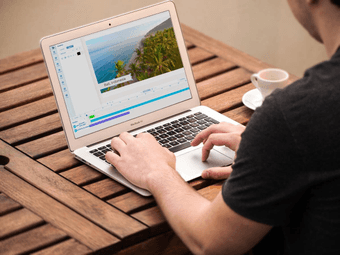
The Flip Video tool lets you flip a video online and see the reflection before anything is processed.
- Upload one video. Common inputs include MP4, MOV, AVI, WebM, and MKV.
- Choose the direction. Use a quick preset, Horizontal, Vertical, or Both, or switch the Horizontal flip and Vertical flip toggles individually. Original clears the selection.
- Watch the live preview. The label in its corner names the active reflection, for example "Horizontal + Vertical."
- Play the clip from start to end. Look at the composition in every shot, not only in the first one.
- Scan for text and logos. Anything readable in the source is now reversed.
- Click Flip Video and wait for processing.
- Download the result, or continue in the full editor.
The reflection applies to the entire frame for the entire video. The tool does not flip a single object, a part of the frame, or a section of the timeline, and it does not duplicate the clip. The result is a new file that has been re-encoded, meaning compressed again on saving, so its size and fine detail may differ slightly from the source.

Advanced: side-by-side reflection and symmetry in the full editor
The symmetrical look, with a line down the middle and the same image reflected on both sides, cannot come from a single flip. It needs two layers: the original, and a mirrored copy, each showing half. The standalone Flip Video tool does not create split screens, duplicates, masks, or animated reflections. You build this in the full Deus.Video editor.
A workable recipe
- Make the mirrored copy. For an exact mirror with unchanged proportions, run the clip through Flip Video with Horizontal selected, and download it. You now have two files: the original and its mirror. The quicker alternative is described after these steps.
- Open the full editor and add both files to the project, starting at the same time on the timeline. Give both clips the same zoom, large enough to cover the canvas from top to bottom.
- Select the original and set its Left value to 0%. Position is measured from the element's center, so the clip's center sits on the left edge of the canvas, and its right half covers the left half of the canvas. The rest falls outside the canvas and is not rendered.
- Select the mirrored copy and set its Left value to 100%. Its left half now covers the right half of the canvas.
- Check the seam. The two halves meet in the middle as reflections of each other. Adjust both Left values by the same amount in opposite directions to choose which part of the picture is mirrored.
- Silence one copy. Set Volume to 0 on one of the clips, so the soundtrack is not doubled.
- Play the whole timeline, then click Download video.
Mirroring a layer by hand in the editor
The editor can also mirror an element directly on the canvas. Select the clip, grab the handle in the middle of one side, and drag it across the opposite edge. The picture narrows to a line and then opens out again as its mirror image. With this method you can add the same file twice and mirror the second copy in place, without a separate pass through Flip Video.
Because you are dragging freehand, the mirrored copy rarely ends up at exactly its original width, and a different width stretches the picture. Compare it with the untouched copy and adjust until both are the same size, or use the Flip Video route when the proportions have to be exact.

For a water-style reflection, do the same vertically: make a vertically flipped copy, and place the two clips one above the other using the Top value.

Planning tips by type of footage
People
Faces tolerate a simple horizontal mirror well. Watch for hair partings, moles, tattoos, and jewelry in a series where viewers know the person. In a symmetry effect, a person crossing the center line merges with their reflection, which can be striking or grotesque. Decide on purpose.
Dance
Mirroring a routine swaps left and right moves. For follow-along teaching, that is often what you want. For choreography credited to someone, or set to lyrics that mention a side, it may be wrong. Symmetry effects suit dance very well, because movement toward and away from the center line creates shapes.
Product
Products are the riskiest subject. Labels, buttons, ports, steering wheels, handedness of tools, and the brand logo all have a correct side. Use a mirror effect on product footage only when none of those are visible, or when the shot is abstract.
Abstract and nature footage
Water, clouds, smoke, light leaks, foliage, and textures are ideal. Nothing in them has a right way around, and symmetry turns them into patterns. These clips also hide the seam of a side-by-side layout.
Text and logos: they are mirrored too
A flip has no idea what is text. Every pixel is reflected, so a street sign, a shirt print, a license plate, a watermark, and any captions already burned into the video all come out in mirror writing.
- Choose clips without visible lettering, or where it is too small or too blurred to read.
- Flip first, and add titles, captions, and your logo afterward, so they stay readable. In the editor they are separate layers on top of the video.
- If a reversed sign is unavoidable, crop it out of the frame with Crop Video, or pick a different take.
- Check brand guidelines. Most brands do not allow a mirrored logo.
Effects at a glance
| Effect | Required operation | Best content | Main risk |
|---|---|---|---|
| Simple mirror image | Horizontal flip in Flip Video | People, scenery, b-roll without lettering | Reversed text and logos |
| Change of screen direction | Horizontal flip | A subject that should face into the layout | Mismatch with neighboring shots; light direction |
| Upside-down reflection look | Vertical flip | Skies, water, abstract footage, transitions | Disorienting if it lasts too long |
| Upside-down without mirroring | Both, which equals a 180° turn | Stylized inserts | Rarely reads as a "mirror" effect |
| Left-right symmetry | Two layers in the full editor: original plus mirrored copy | Dance, architecture, nature, abstract textures | Visible seam; subjects merging at the center; doubled audio |
| Water-style reflection | Two layers in the full editor: original plus vertically flipped copy | Skylines, landscapes, sunsets | A horizon that does not line up at the join |
| Mirror effect on one section only | Split the clip, flip that section, reassemble in an editor | Music videos, transitions | Extra exports, each with re-encoding |
Conclusion
A mirror effect can be one click or a small composition. For a reflected frame, choose Horizontal or Vertical in the flip tool and check the direction, the light, and above all the lettering. For true symmetry, make a mirrored copy and place it beside the original in the full editor. In both cases, pick footage with nothing that has a correct side, and add your own text after the flip.
Have a clip that would look better facing the other way? Open the Flip Video tool, choose a direction, and watch the preview from start to end before you download.
Frequently asked questions
What is the difference between mirroring and flipping a video?
In everyday use, they mean the same thing. Mirroring normally refers to a horizontal flip, which swaps left and right. A vertical flip swaps top and bottom and is sometimes called a vertical mirror.
Can Flip Video create a split-screen mirror effect?
No. The standalone tool reflects the whole frame once. It does not duplicate the clip or build split screens. A symmetrical layout needs two layers in the full editor, where a layer can be mirrored by dragging a side handle across its opposite edge.
Why is the text in my mirrored video backward?
Because the flip reflects every pixel, including any lettering in the scene and any captions that were already part of the file. Flip clips without readable text, or add your text after flipping.
Does mirroring affect the audio?
No. The sound is unchanged and plays forward as before. In a two-layer symmetry layout, mute one of the copies, so the audio is not doubled.
Can I mirror only part of the video?
Not in the standalone tool, which flips the whole file. Split out the section you want, flip it, and join the pieces again in an editor.
Will viewers notice a horizontal mirror?
Usually not, if nothing in the shot has a known orientation. They will notice reversed text, a familiar place that looks wrong, a known person's asymmetrical features, or shadows that change direction between shots.